Does drink driving go on your criminal record in QLD? When a conviction is recorded, how long it lasts, when it is spent and when you must still disclose it.
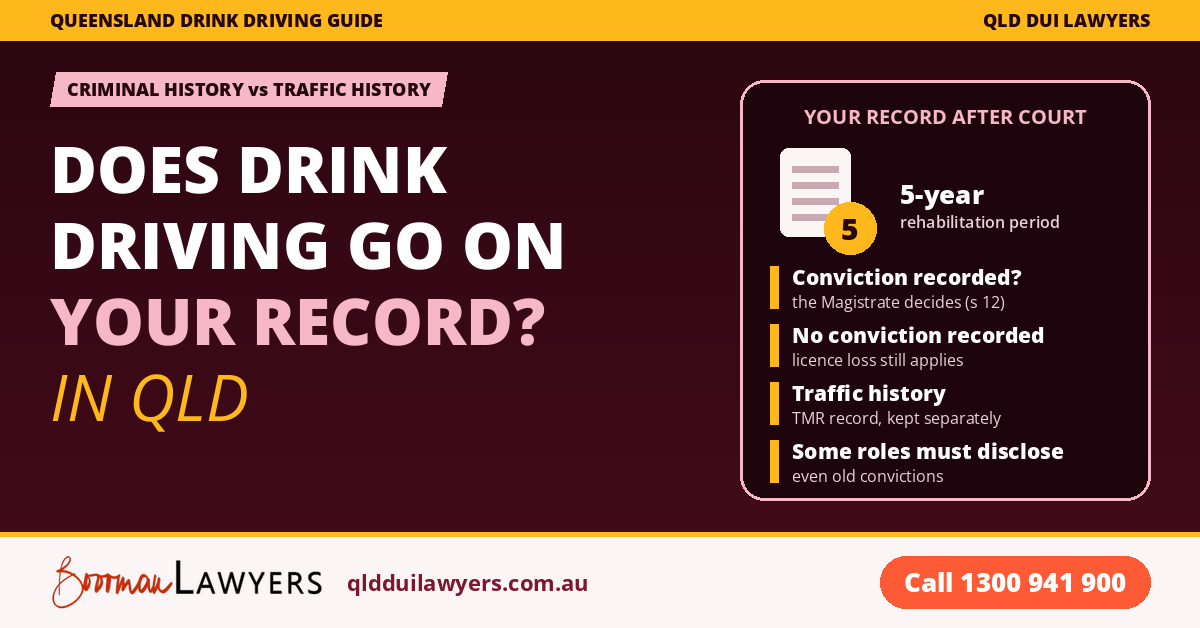
Short answer: yes, a drink driving charge in QLD can end up on your criminal record. If the Magistrate records a conviction, it becomes part of your criminal history. For most people it stops needing to be disclosed after 5 years, as long as there was no jail term over 30 months, any fine has been paid and the conviction hasn’t been revived. If the Magistrate decides not to record a conviction, you can generally say you have no conviction, but there are exceptions. Either way, the offence goes on your Transport and Main Roads traffic history and still counts for your licence.
This guide explains the difference between your criminal history and your traffic history, how long a drink driving conviction lasts in Queensland, when you still have to disclose it, and what you can do before court to protect your record.
Is drink driving a criminal offence in QLD?
Drink driving is an offence under section 79 of the Transport Operations (Road Use Management) Act 1995 (the TORUM Act). It isn’t just a traffic fine. Every drink driving offence involving a motor vehicle under section 79 carries a possible jail term as well as a fine and a licence disqualification, and the charge is heard in the Magistrates Court. Under section 123V, a proceeding for an offence against the TORUM Act is a summary proceeding under the Justices Act 1886, which is why drink driving charges are dealt with by a Magistrate rather than a judge and jury.
The one exception to going to court is a first low range offence (0.05 to under 0.10) that police deal with by an infringement notice under section 79H. That option is only available if you haven’t committed a drink driving offence in the previous 5 years and you hold a Queensland driver licence. It can’t be used for learner, P plate, probationary, provisional or restricted licence holders, interlock drivers, or drivers of certain vehicles such as trucks, buses and taxis. Even a paid infringement notice is treated as a conviction under the TORUM Act for licence and repeat offence purposes, and it goes on your traffic history.
The penalties themselves are set out on our drink driving offences and penalties page.
Criminal history and traffic history are two different records
A lot of the confusion comes from the fact that there are two separate records in Queensland.
- Your criminal history is held by the Queensland Police Service. Under the Criminal Law (Rehabilitation of Offenders) Act 1986, your criminal history means the convictions recorded against you for offences. A drink driving conviction that the Magistrate records is part of it. A charge that is dismissed, or a conviction set aside or quashed on appeal, is not part of your criminal history (section 5).
- Your traffic history is held by the Department of Transport and Main Roads (TMR). According to TMR’s licence and traffic history page, it includes traffic offences dealt with under the TORUM Act, the result, the fine, and any periods of licence suspension, cancellation or disqualification. A traffic history report shows the last 5 years unless you ask for a different period.
The two records work differently. Whether the Magistrate records a conviction makes a big difference to your criminal history. It makes no difference to your traffic history or your licence. The TORUM Act defines convicting a person to include a court finding you guilty or accepting your guilty plea whether or not a conviction is recorded (schedule 4). So the disqualification, and the repeat offence rules for any later offence, apply either way.
Will the Magistrate record a conviction?
Under section 12 of the Penalties and Sentences Act 1992, the Magistrate has a discretion to record or not record a conviction. They must consider all the circumstances, including:
- the nature of the offence;
- your character and age; and
- the impact a recorded conviction would have on your economic or social wellbeing, or your chances of finding employment.
There are limits. A court can only order imprisonment if it records a conviction (section 152), and the same applies to an intensive correction order (section 111). A fine can be imposed with or without a conviction being recorded (section 44).
No one can promise you a no conviction outcome. It depends on the reading, the circumstances, your history and the material you put before the court. Our page on avoiding a DUI conviction in Queensland explains how the application works and what evidence helps.
What “no conviction recorded” means for your record
If no conviction is recorded, section 12(3) says it is taken not to be a conviction for any purpose, unless a law says otherwise. Legal Aid Queensland explains that the matter will still appear on your criminal history, noted as having no conviction recorded, and that generally you can say you don’t have any convictions.
That isn’t the whole story, though:
- It still counts if you offend again. A conviction without recording has the same result as a recorded one in proceedings for a later offence (section 12(4)(b)). If you are charged again, the court will know about it.
- Read the question carefully. Legal Aid Queensland points out that a form might ask whether you have ever been charged, found guilty or pleaded guilty. Those are different questions from whether a conviction was recorded.
- Some applications require more. For certain roles, such as a blue card for working with children, you still have to disclose that you were found guilty or pleaded guilty even though no conviction was recorded. Section 9A of the Rehabilitation of Offenders Act also requires applicants for some positions to disclose convictions that are deemed not to be convictions.
How long does a drink driving conviction stay on your record in QLD?
The record itself doesn’t disappear. What changes over time is whether you have to disclose it. Under the Criminal Law (Rehabilitation of Offenders) Act 1986, once the “rehabilitation period” for a conviction has expired, the conviction is often called “spent”.
For a conviction that is not on indictment, which includes a drink driving conviction in the Magistrates Court, the rehabilitation period is 5 years from the date the conviction is recorded (section 3). Three things can change that:
- A jail term over 30 months. A rehabilitation period only applies if no term of imprisonment was imposed, or the term was not more than 30 months, whether or not you actually served it (section 3(2) and (2A)). The maximum jail term for any single drink driving offence under section 79 is 18 months, so this mainly matters for people sentenced for more serious offences at the same time.
- Unpaid court orders. If a court order made for the conviction, such as a fine, hasn’t been satisfied within the 5 years, the period runs until the order is satisfied. Paying your fine matters.
- Another conviction. If you are convicted again, the rehabilitation period can start again, or an expired conviction can be revived (section 11). Where the later offence is one that can be dealt with in the Magistrates Court, that only happens if the court orders it, having regard to the public interest.
The Queensland Government’s page on understanding criminal history records summarises the same rules.
What happens once a conviction is spent?
Once the rehabilitation period has expired and the conviction hasn’t been revived:
- it is lawful for you to say you have not been convicted of the offence, except in the situations the Act preserves (section 8);
- other people who know the period has expired must not disclose the conviction, with some exceptions (section 6); and
- a person assessing your fitness for a profession, occupation or other purpose must disregard it, unless the law expressly requires disclosure or requires them to consider your criminal history (section 9).
A spent conviction can still come up in some places. Legal Aid Queensland lists examples such as a prosecutor raising your history when you are being sentenced for another offence, a court or community corrections making an order about you, and applications for certain jobs. The Act also allows police to keep, use and share information among police services (section 7(2)).
When you may still have to disclose it
Section 9A of the Act lists positions where an applicant who is asked must disclose their criminal history, even old or spent convictions, for the offences listed against that position. For many of these the list covers any contravention of the law, which would include drink driving. Examples include:
- police officers and people employed or engaged by the Queensland Police Service;
- corrective services officers;
- justices of the peace and commissioners for declarations;
- security providers under the Security Providers Act 1993;
- people registered, licensed or approved under the Child Protection Act 1999;
- certain casino and liquor licensing applicants; and
- people applying for admission as a lawyer or for a practising certificate.
For some other roles, such as teachers in state schools, the table only covers specific types of offences, not every offence. The rules are technical, so if you are unsure whether a form requires you to disclose a drink driving matter, get advice before you answer.
Will a drink driving conviction affect my job or travel?
It can. The Queensland Government notes that a criminal history may be checked when you apply for a job, volunteer, work with children, apply for insurance or get an overseas visa. If a conviction is recorded and you need a National Police Certificate, the Queensland Police Service explains that the certificate lists your “disclosable” court outcomes from police services Australia-wide, released under the law and policy of each state and territory.
If your job involves driving, the licence disqualification is often the more immediate problem. Because the disqualification applies whether or not a conviction is recorded, it is worth checking early whether you might be eligible for a work licence.
For overseas travel, visa and entry rules are set by each country. Check the official government website of the country you plan to visit, and answer any questions about your history honestly and carefully.
What changes from 1 December 2026?
The Transport and Other Legislation Amendment Act 2026 brings in minimum fines for drink and drug driving offences from 1 December 2026. If the Magistrate decides to impose a fine with no other penalty apart from disqualification, the fine must be at least the new minimum. This applies to offences committed from 1 December 2026.
The changes don’t alter the Magistrate’s discretion under section 12 of the Penalties and Sentences Act to record or not record a conviction, and they don’t change the rehabilitation periods. Our penalties page sets out the new minimums.
What you can do before court to protect your record
- Get your traffic history. You can apply to TMR for your traffic history. Any earlier drink or drug driving offence in the last 5 years changes the penalties (see our guide to a second drink driving offence in QLD).
- Work out what a recorded conviction would actually cost you. If it would affect your current job, a job offer, a professional registration, study or a visa, get written evidence of that. The impact on your employment is one of the things the Magistrate must consider.
- Gather character references. References should show the writer knows about the charge.
- Show what you have done since. Completing a course such as the Queensland Traffic Offenders Program, or getting help with your drinking if that is relevant, shows the court you have taken the offence seriously.
- Understand the court day. Our guide to the DUI court process explains what happens when you plead guilty and how the Magistrate approaches sentence.
- Pay your fine. An unpaid fine can keep the rehabilitation period running past 5 years.
If you plan to handle a guilty plea yourself, DIY DUI Method has a plain English guide on no conviction recorded in Queensland.
Talk to Boorman Lawyers
If you’ve been charged with drink driving and you’re worried about your record, we can look at whether a no conviction outcome is realistic in your case, help you gather the evidence that supports it and present it to the Magistrate. Joshua Boorman has been practising traffic law since 2008, and we appear in Magistrates Courts across Queensland. You can see how we charge on our legal costs page.
Call 1300 941 900 or make an enquiry online.
Frequently asked questions
Does drink driving go on your criminal record in QLD?
It can. If the Magistrate records a conviction, the drink driving conviction becomes part of your Queensland criminal history. If no conviction is recorded, it is generally not treated as a conviction, although it is still noted on your criminal history and still counts for your licence and any later offence.
How long does a drink driving conviction stay on your record in QLD?
The record is not deleted, but for a Magistrates Court conviction the rehabilitation period is 5 years from the date the conviction is recorded. After that you generally don’t have to disclose it, provided there was no jail term over 30 months, any fine has been paid and the conviction has not been revived.
Can I get no conviction recorded for drink driving in QLD?
In some cases. Under section 12 of the Penalties and Sentences Act 1992 the Magistrate decides, considering the nature of the offence, your character and age, and the impact a conviction would have on you. A conviction must be recorded if the court orders imprisonment. The licence disqualification applies either way.
Does a drink driving charge go on my traffic history?
Yes. Your TMR traffic history includes offences dealt with under the TORUM Act, the result, the fine and any disqualification. This is separate from your criminal history, and the no conviction recorded decision does not change it.
Do I have to tell an employer about a drink driving conviction?
It depends on what you are asked and the role you are applying for. Once the 5-year rehabilitation period has passed you can generally say you have no conviction, but some positions, such as police, security providers and lawyers, require disclosure of old convictions when asked.
This article is general information about Queensland law as at 25 November 2026. It is not legal advice about your situation. Outcomes depend on the facts of each case.
General information only, not legal advice. Outcomes depend on the facts of each case.