You can't refuse a breath test in QLD. What refusing the roadside test or breath analysis means for fines, jail, your licence and possible defences.
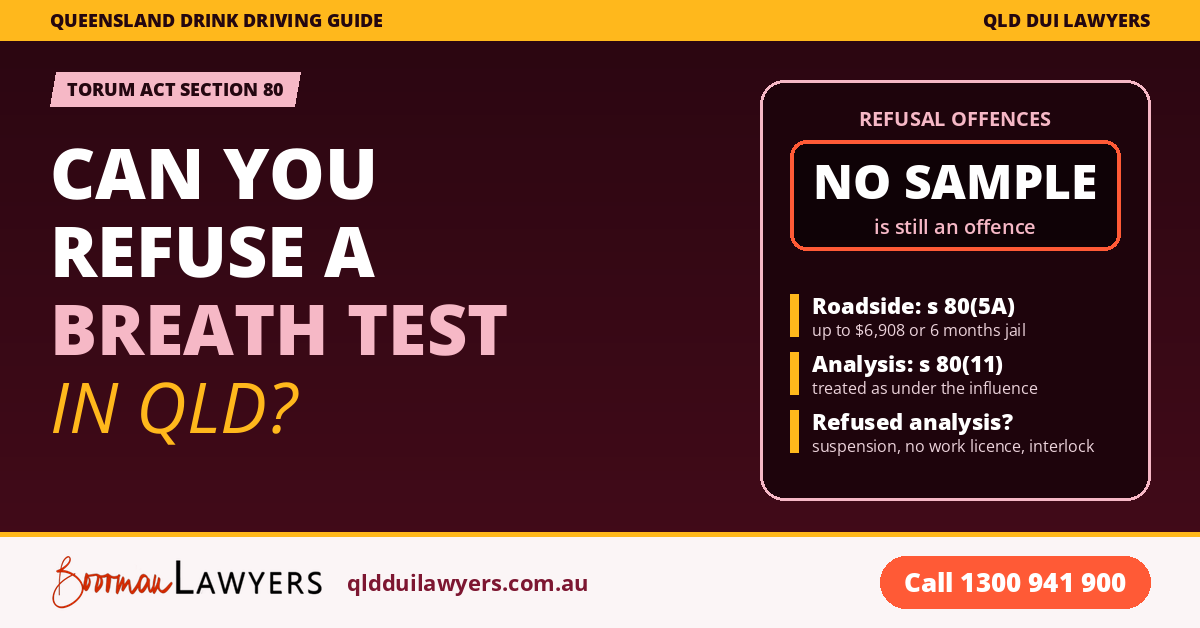
Short answer: no. In Queensland you can’t lawfully refuse a breath test when a police officer requires one. Refusing the roadside test is its own offence, with a maximum of 40 penalty units ($6,908) or 6 months imprisonment. Refusing the later breath analysis at the station (or a blood test) is more serious again: the law treats it as if you were driving under the influence, which means an immediate licence suspension, at least 6 months off the road if you’re convicted, no work licence and the interlock program.
People refuse for all sorts of reasons. Some panic. Some think “no reading, no case”. Some believe they were stopped unfairly. This guide explains the two different refusal offences, what each one means for your licence, the narrow defences the law allows, and what to do if you’ve already been charged.
Do you have to do a breath test in Queensland?
Yes. Under section 80 of the Transport Operations (Road Use Management) Act 1995 (the TORUM Act), a police officer can require a person to give a specimen of breath for a breath test, a specimen of saliva for a saliva test, or both. The power covers anyone the officer finds, or reasonably suspects was in the last 3 hours:
- driving a motor vehicle;
- attempting to put a motor vehicle in motion; or
- in charge of a motor vehicle.
Police don’t need to suspect you’ve been drinking. Legal Aid Queensland’s guide to drink driving offences makes the point directly: police do not have to suspect you of being over the limit to ask for a random breath specimen.
The same power applies after a crash that causes injury, death or property damage (section 80(2A)). The requirement must be made as soon as practicable and within 3 hours of the event that allows police to ask (section 80(4)). Police can also ask for more than one specimen if the first one doesn’t work or the device fails (section 80(2B) and (2C)).
The two refusal offences in Queensland
Most people talk about “refusing a breath test” as one thing. Queensland law splits it into two stages, and the difference matters a great deal.
1. Refusing the roadside breath test (section 80(5A))
The roadside test is the quick screening test into a handheld device, usually at a random breath testing site or after you’re pulled over. Under section 80(5A), you commit an offence if you:
- fail to provide the specimen; or
- fail to provide it in the way the officer directs.
That second part catches more people than you might think. Under section 80(1A), you’re treated as not having provided a specimen unless it is enough for the test to be done and is given in a way that lets the test work. Blowing too softly, stopping early or blowing around the mouthpiece can all lead to a charge.
The maximum penalty is 40 penalty units ($6,908) or 6 months imprisonment. A Queensland penalty unit has been worth $172.70 since 1 July 2026 (Penalties and Sentences (Penalty Unit Value) Amendment Regulation 2026).
2. Refusing the breath analysis or a blood test (section 80(11))
If the roadside test shows you’re over your limit, or you fail or refuse the roadside test, police can take you to a police station, a booze bus or another authorised place (section 80(6)). There, they can require a specimen of breath for analysis on an approved breath analysing instrument, a saliva specimen for analysis, or a blood specimen for a laboratory test (section 80(8)).
So refusing at the roadside doesn’t end the matter. It can lead straight to a request for the formal analysis.
If you were driving, attempting to put a vehicle in motion or in charge of it, and you fail to provide the specimen for analysis, section 80(11) says two things:
- you are guilty of an offence that is taken to be an offence against the appropriate part of section 79(1), which is driving under the influence; and
- you are liable to the same punishment in all respects, including licence disqualification, as if you had committed that offence.
In plain terms, a refusal at this stage is punished like the most serious drink driving charge, the same charge that applies to a reading of 0.150 or more. Refusing doesn’t protect you from a high reading. It puts you in that category whatever your actual reading would have been.
Penalties for refusing a breath test in QLD at a glance
| Refusing the roadside test (s 80(5A)) | Refusing analysis or blood (s 80(11)) | |
|---|---|---|
| Maximum penalty (first offence) | 40 penalty units ($6,908) or 6 months imprisonment | Same as driving under the influence: 40 penalty units ($6,908) or 9 months imprisonment |
| Licence suspended straight away when charged? | Not under section 79B | Yes, until the charge is dealt with or withdrawn |
| Disqualification if convicted | Not automatic. The Magistrate may disqualify you | Automatic. At least 6 months for a first offence, longer with earlier convictions |
| Work licence (s 87) | Possible if you are disqualified and meet the strict criteria | Not available |
| Interlock after disqualification | Not triggered by this offence alone | Yes, for a refusal of breath (or blood taken to test for alcohol) |
Sources: TORUM Act sections 79(1), 79B, 80(5A), 80(11), 86, 87 and 91I; Penalties and Sentences Act 1992 section 187. These are maximums and statutory rules. The penalty in any case depends on its facts and your traffic history. For every alcohol limit side by side, see our page on drink driving offences and penalties in Queensland.
What happens to your licence if you refuse
Immediate suspension for refusing analysis
Under section 79B, your Queensland licence is suspended as soon as you’re charged under section 80(11) with failing to provide a breath, saliva or blood specimen for analysis (where a motor vehicle was involved). If you hold an interstate licence, your right to drive on Queensland roads is suspended instead. The suspension lasts until the charge is dealt with by the court, or is withdrawn or discontinued. The Queensland Government’s drink driving penalties page confirms this.
In limited cases a court can make a section 79E order letting you keep driving until your case is decided. Eligibility is narrow, and Legal Aid Queensland notes this option is mainly useful if you intend to plead not guilty on good advice. See our page on immediate police suspension.
Disqualification
For a section 80(11) refusal, the disqualification rules for section 79(1) apply. Under section 86, a first offence carries an automatic 6 month disqualification, and the Magistrate can order longer. Earlier convictions in the 5 years before the new conviction push this up, to as much as 2 years for repeat under the influence offences. The court can take into account time you have already spent suspended under section 79B (section 86(7)).
For a roadside refusal under section 80(5A), section 86 doesn’t set an automatic period. The Magistrate can still disqualify you under section 187 of the Penalties and Sentences Act 1992 if satisfied it is in the interests of justice, whether or not a conviction is recorded.
Work licence
A section 87 work licence is only possible after a conviction under section 79 or section 80(5A), and only if you meet every requirement, including showing extreme hardship to you or your family through loss of your livelihood (section 87). A work licence can’t be granted where the disqualification came from a section 79(1) conviction (section 87(5)(da)). Because a refusal of analysis is taken to be a section 79(1) offence, a work licence isn’t available for it. Read more on our work licence (s 87) page.
Interlock
Failing to provide a breath specimen for analysis, or a blood specimen where police wanted to test for alcohol, is a “drink driving offence” for the interlock program (section 91I). The Queensland Government’s interlocks page lists “failing to provide a blood/breath specimen for analysis” as a high-risk offence. If you don’t take part when your disqualification ends, you can’t drive for 5 years. Our alcohol interlock page explains how the program works.
Repeat offences and your car
For repeat drink driving offences, the Queensland Government says your car may be impounded if you fail to provide a specimen of breath or blood. If you have earlier drink driving convictions, get legal advice before your first court date.
Is there a defence to refusing a breath test?
The TORUM Act gives some narrow defences. They are not easy to make out, and you carry the burden of proving them.
For the roadside test (section 80(5B)), you are not guilty if:
- immediately after the requirement is made, you hand the officer a certificate from a doctor, in the approved form, stating that because of a stated illness or disability you can’t provide the specimen, or that giving it could harm your health; or
- you satisfy the court that the requirement was not lawfully made, that you were incapable of providing the specimen because of what happened, or that there was some other reason of a substantial character for not providing it, other than a desire to avoid giving evidence.
For analysis or blood (section 80(11A)), the same three grounds apply: the requirement was not lawfully made, you were incapable of providing the specimen because of the events that occurred, or there was some other substantial reason other than wanting to avoid evidence.
Common examples that get raised include a genuine medical condition affecting your breathing, an injury from a crash, or a requirement made outside the 3 hour window. Whether any of these work depends on the evidence, often medical evidence. “I didn’t think I was over” or “I didn’t want to give them a reading” is not a defence. Our DUI defences in Queensland page goes through what can and can’t be argued.
Legal Aid Queensland also notes that you have no right to ask for a blood test instead of a breath test unless you can give police a medical certificate showing you can’t give a breath specimen.
Changes starting 1 December 2026
The Transport and Other Legislation Amendment Act 2026 brings in minimum fines for section 79 offences from 1 December 2026. For a first section 79(1) offence, if the Magistrate imposes only a fine (with disqualification), the fine must be at least 10 penalty units ($1,727). The maximum penalties don’t change.
A section 80(11) refusal attracts the same punishment as section 79(1), but the Act doesn’t spell out how the new minimum works for refusals, or whether it applies to an offence committed before 1 December 2026. If your case is affected, ask a lawyer. The 1 December changes to section 80 itself are technical and don’t change the refusal penalties described above.
I’ve been charged with refusing a breath test. What now?
- Don’t drive if you’ve been suspended. Driving while suspended is a separate and more serious problem.
- Check which section you’ve been charged under. Your notice to appear or bench charge sheet will say section 80(5A) or section 80(11). As the table shows, the consequences are very different.
- Get your traffic history from the Department of Transport and Main Roads. Earlier convictions in the past 5 years change the penalties and the licence outcome.
- Write down what happened while it’s fresh: the time you last drove, when the test was asked for, what you were told, and any medical issue or injury. If you have a medical condition, get records from your doctor.
- Get advice before you plead. If there is a real defence, you’ll want to know before your first mention. If you plan to plead guilty, preparation such as character references and the Queensland Traffic Offenders Program can help you present your best case. Legal Aid Queensland notes the Magistrate may consider a change in attitude after the program.
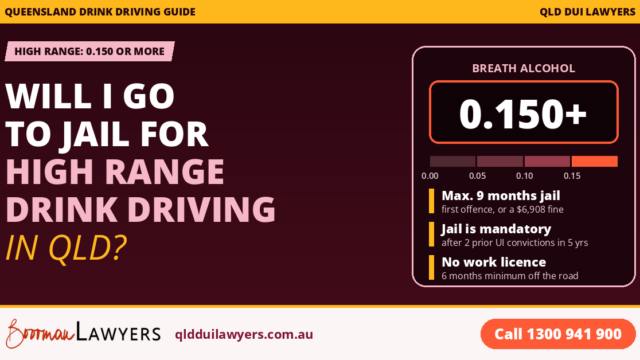
Our guide to the DUI court process in Queensland explains what happens on the day. If you’re worried about jail, our post on jail for high range drink driving in QLD covers how the Magistrate approaches section 79(1) sentences, which is the same framework that applies to a refusal of analysis.
If you’re planning to plead guilty and want to prepare yourself, DIY DUI Method has guides to Queensland licence disqualification and the Queensland sentencing process.
Talk to Boorman Lawyers
If you’ve been charged with failing to provide a specimen, we can look at the police facts, the timing and any medical issues, explain which charge you’re really facing and what is realistically in play, and help you prepare for court. Boorman Lawyers have 19+ years’ experience in drink and drug driving cases, and we appear in Magistrates Courts across Queensland. You can see how we charge on our legal costs page.
Call 1300 941 900 or make an enquiry online.
Frequently asked questions
Can you refuse a breath test in QLD?
No. If a police officer requires you to do a breath test, refusing or not blowing properly is an offence under section 80(5A) of the TORUM Act, with a maximum of 40 penalty units ($6,908) or 6 months imprisonment.
Is refusing a breath test worse than failing one in Queensland?
It can be. Refusing the breath analysis at the station, or a blood test, is treated as driving under the influence, the same category as a reading of 0.150 or more. That means immediate suspension, at least 6 months disqualification for a first offence, no work licence and the interlock program.
Do police need a reason to breath test you in QLD?
No. Police can require a breath test from a person driving, attempting to drive or in charge of a vehicle without suspecting they have been drinking. The requirement must be made within 3 hours of the driving.
Can I get a work licence if I refused a breath test?
Not if you were convicted of refusing the analysis or blood test under section 80(11), because it is taken to be a section 79(1) offence. A work licence may be possible after a roadside refusal under section 80(5A) if the Magistrate disqualifies you and you meet the strict section 87 criteria.
Is a medical condition a defence to refusing a breath test?
It can be. For the roadside test, you can hand police a doctor’s certificate in the approved form straight away, or prove to the court that you were incapable of giving the specimen or had another substantial reason. Medical evidence is usually needed.
This article is general information about Queensland law as at 18 November 2026. It is not legal advice about your situation. Outcomes depend on the facts of each case.
General information only, not legal advice. Outcomes depend on the facts of each case.