Jail is possible for high range drink driving in QLD, but it is not the starting point for a first offence. Penalties, mandatory jail and your licence.
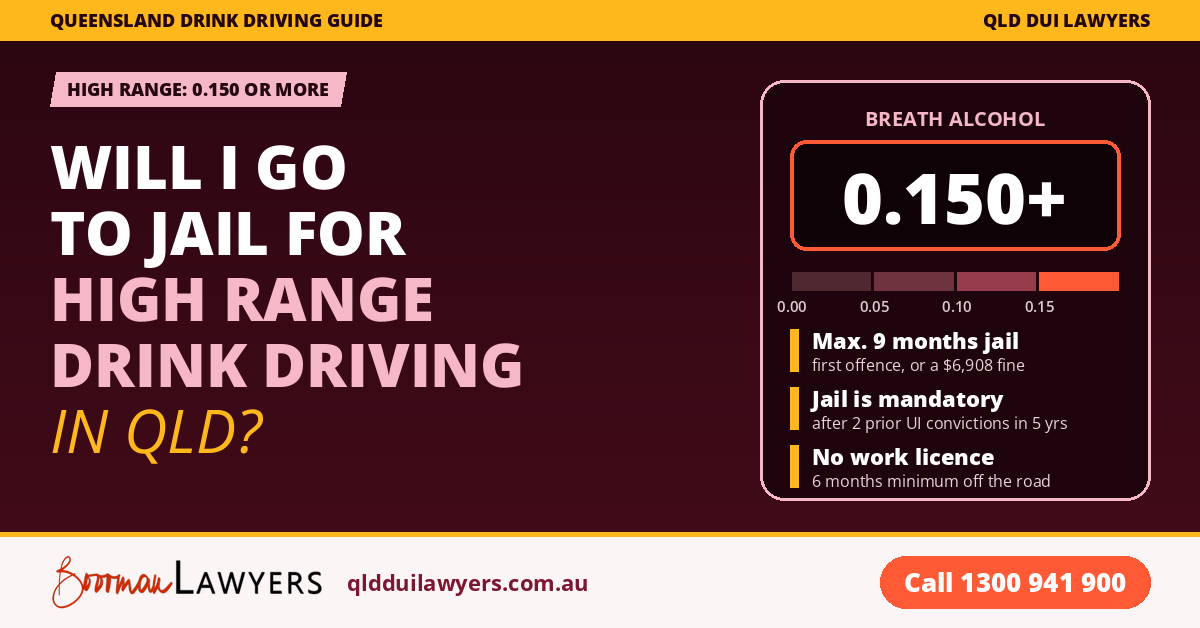
Short answer: jail is possible for high range drink driving in Queensland, but for a first offence it is not the starting point. The maximum for a first offence is 9 months imprisonment or a fine of up to $6,908. The Magistrate must treat imprisonment as a last resort. The picture changes with a bad record: if you have two earlier under the influence (or certain dangerous driving) convictions in the past 5 years, the law says the Magistrate must impose imprisonment.
This guide explains what the law says, what pushes a case toward jail, what happens to your licence, and how to prepare for court.
What is high range drink driving in Queensland?
You are over the high alcohol limit if your blood or breath alcohol concentration is 0.150 or more (section 79A of the Transport Operations (Road Use Management) Act 1995, often called the TORUM Act).
There is no separate “high range” offence. Instead, if the court is satisfied you were over the high alcohol limit, you are conclusively presumed to have been under the influence of liquor (section 79(3)). You are charged with driving, attempting to put a vehicle in motion, or being in charge of a vehicle while under the influence under section 79(1).
A high range charge cannot be dealt with by an on-the-spot fine. It goes to the Magistrates Court. For a side-by-side look at every alcohol limit, see our page on drink driving offences and penalties in Queensland.
The maximum penalties for high range drink driving
A Queensland penalty unit has been worth $172.70 since 1 July 2026 (Penalties and Sentences (Penalty Unit Value) Amendment Regulation 2026). These are the maximums under section 79 of the TORUM Act:
| Your history in the 5 years before conviction | Maximum penalty | Automatic disqualification |
|---|---|---|
| No relevant previous conviction | 40 penalty units ($6,908) or 9 months imprisonment | 6 months |
| One previous lower range conviction (for example 0.050 or middle range) | 42 penalty units ($7,253.40) or 1 year imprisonment | 9 months |
| Two or more previous lower range convictions | 72 penalty units ($12,434.40) or 18 months imprisonment | 1 year |
| One previous under the influence conviction | 72 penalty units ($12,434.40) or 18 months imprisonment | 1 year |
| Two previous under the influence convictions | Imprisonment must be imposed as the whole or part of the punishment | 2 years |
Sources: TORUM Act section 79(1), (1A), (1C), (1D) and (1E), and section 86(1), (1A), (1B), (1F) and (1G). Some earlier dangerous driving convictions are treated like an earlier under the influence conviction. Which earlier offences count is technical, so check your traffic history before court.
A maximum penalty is reserved for the worst cases. It is not what most people receive. The Queensland Government’s drink driving penalties page sets out the same first offence figures.
When jail is mandatory in Queensland
Section 79(1C) of the TORUM Act is the rule that people worry about most. If, in the 5 years before your conviction, you have been convicted twice of driving under the influence (or of certain dangerous driving offences, or a mix of the two), the Magistrate must impose imprisonment as the whole or part of the punishment.
Legal Aid Queensland puts it simply in its guide to drink driving offences: the court must include a jail penalty if you are convicted of 3 major offences within a 5 year period.
The 5 years is counted back from the date of the new conviction, not the date you were caught. And under the TORUM Act, a plea or finding of guilty counts as a conviction even if no conviction was recorded, so an earlier “no conviction recorded” outcome can still count. If this rule might apply to you, get legal advice early.
Why jail is not the starting point for a first offence
Under section 9(2)(a) of the Penalties and Sentences Act 1992, a sentencing court must have regard to two principles: imprisonment should only be imposed as a last resort, and a sentence that allows you to stay in the community is preferable.
There is an important exception. Those principles do not apply if the offence resulted in physical harm to another person (section 9(2A)). A high range reading combined with a crash that injured someone is treated very differently from a random breath test with no other issues.
Legal Aid Queensland notes that you may go to jail if found guilty of driving with a high range reading or for repeat offences. So jail is a real possibility at this level. But for a first offence with no injury and nothing else aggravating, the law points the Magistrate first toward penalties that keep you in the community. Every case turns on its own facts, and no one can promise an outcome.
What makes a jail sentence more likely?
Section 9(2) of the Penalties and Sentences Act lists what the Magistrate must consider. In a high range case, the things most likely to push toward jail include:
- Your traffic and criminal history. Earlier drink or drug driving convictions, especially within 5 years, raise the maximum and can make jail mandatory.
- How high the reading was. The court must consider the nature and seriousness of the offence (section 9(2)(c)), and a very high reading is more serious.
- The manner of driving and any harm. A crash, injury, damage or dangerous driving makes the offence much more serious. The court must consider any damage, injury or loss caused (section 9(2)(e)).
- Children in the car. The court must consider the effect of the offence on any child under 16 who was directly exposed to it (section 9(2)(c)(ii)).
On the other side, the Magistrate must consider your character and age, the hardship a sentence would cause, and the effect on anyone you are the primary carer for (section 9(2)(f), (fa) and (fb)). An early guilty plea must be taken into account and can reduce the sentence (section 13).
The sentencing options the Magistrate can choose from
The options under the Penalties and Sentences Act, from least to most serious, are:
- Release, with or without a good behaviour recognisance of up to 3 years (section 19).
- A fine, up to the maximum above. A fine can be imposed with or without recording a conviction (section 44).
- Probation (section 90) or a community service order (section 100). Both can be made with or without recording a conviction.
- Intensive correction order. For a jail term of 1 year or less, the court can order that it be served in the community under supervision instead of in prison (sections 112 and 113). A conviction must be recorded (section 111).
- Suspended sentence. The court can suspend all or part of a jail term (section 144). A conviction must be recorded (section 143).
- Imprisonment served in custody.
Whatever the penalty, the licence disqualification still applies. See our DUI court process page.
Minimum fines from 1 December 2026
The Transport and Other Legislation Amendment Act 2026 adds minimum fines from 1 December 2026. If the Magistrate imposes only a fine and disqualification, the fine for a first under the influence offence must be at least 10 penalty units ($1,727), with higher minimums for repeat offences. The maximums do not change. If your offence happened before 1 December 2026, ask a lawyer how the change applies to you.
Can you avoid a conviction for high range drink driving?
It is possible, but never guaranteed. Under section 12 of the Penalties and Sentences Act, the Magistrate decides whether to record a conviction, having regard to all the circumstances, including the nature of the offence, your character and age, and the impact a conviction would have on your economic or social wellbeing or your chances of finding work.
In Queensland, not recording a conviction does not stop the licence disqualification or the interlock. The TORUM Act counts a plea or finding of guilty as a conviction for those purposes. Our page on avoiding a DUI conviction explains this in more detail.
Your licence: suspension, disqualification and the interlock
Immediate suspension. Your licence is suspended as soon as you are charged with driving under the influence (section 79B). The suspension generally lasts until the charge is dealt with by the court or withdrawn. In limited cases you can apply to the Magistrates Court to keep driving until your case is finished, but eligibility is narrow, so get advice quickly. See our page on immediate licence suspension and section 79E orders.
Disqualification. On a first offence you are disqualified for 6 months automatically, without the Magistrate having to make an order (section 86(1)). The Magistrate can order a longer period, or disqualify you absolutely (section 86(5)).
No work licence. A section 87 restricted (work) licence is not available when the disqualification is for an offence under section 79(1), which includes every high range charge (section 87(5)(da)). See our work licence page for who can apply.
Alcohol interlock. A high range conviction is a drink driving offence for the interlock rules (section 91I). When your disqualification ends, you can only drive a nominated vehicle fitted with an interlock until you complete a prescribed period of 12 months (sections 91K, 91M and 91N). If you do not complete it, the interlock condition lasts for 5 years. Read more on our alcohol interlock page and on the Queensland Government’s Alcohol Ignition Interlock Program page.
Repeat offences. The Queensland Government says that for a repeat offence at 0.15 or more, your car may also be impounded.
How to prepare for your court date
Before court:
- Get your traffic history from the Department of Transport and Main Roads. Legal Aid Queensland recommends doing this before you get legal advice, because your history decides which penalties apply.
- Read the police facts carefully. If the reading, times or description of the driving are wrong, raise it before you plead.
- Collect character references from people who know you well and know about the charge.
- Consider a traffic offenders program. Legal Aid Queensland says the Magistrate may consider a change in attitude after you take part in the Queensland Traffic Offenders Program.
- Get help with alcohol use if it is an issue, and keep evidence of it, such as counselling records.
- Gather evidence about your work and family, especially if you will ask the Magistrate not to record a conviction.
If you plan to plead guilty and represent yourself, the DIY DUI Method has step-by-step guides on the Queensland drink driving sentencing process, character references for a Queensland drink driving charge and the Queensland Traffic Offenders Program. If you have earlier drink driving convictions, or there was a crash or injury, get legal advice first.
Talk to Boorman Lawyers
If you have been charged with high range drink driving, we can review the police facts and your traffic history, explain which penalties are realistically in play, and help you prepare the material the Magistrate needs to see. Boorman Lawyers have 19+ years’ experience in drink and drug driving cases, and we appear in Magistrates Courts across Queensland. You can see how we charge on our legal costs page.
Call 1300 941 900 or make an enquiry online.
Frequently asked questions
Will I go to jail for a first offence high range drink driving in QLD?
It is possible, but jail is not the starting point. The maximum is 9 months imprisonment or a $6,908 fine, and imprisonment must be a last resort unless someone was physically harmed. The outcome depends on your reading, the driving and your history.
When is jail mandatory for drink driving in Queensland?
If, in the 5 years before your conviction for driving under the influence, you have two earlier under the influence convictions (or certain dangerous driving convictions), the Magistrate must impose imprisonment as the whole or part of the punishment under section 79(1C) of the TORUM Act.
What is the fine for high range drink driving in QLD?
The maximum for a first offence is 40 penalty units ($6,908). From 1 December 2026, if the Magistrate imposes only a fine and disqualification, the fine for a first offence must be at least $1,727.
Can I get a work licence for high range drink driving in Queensland?
No. A section 87 work licence is not available for an under the influence conviction, which includes any reading of 0.150 or more.
How long will I lose my licence for high range drink driving?
For a first offence, 6 months automatically, and the Magistrate can order longer. It is 9 months to 2 years with certain earlier convictions in the past 5 years. The interlock program follows.
This article is general information about Queensland law as at 16 November 2026. It is not legal advice about your situation. Outcomes depend on the facts of each case.
General information only, not legal advice. Outcomes depend on the facts of each case.